If you poll Indians on which institution they respect and trust the most, the armed forces always tops the list. From building bridges over flood waters to leading flag marches during riots, from securing our borders in sub-zero temperatures to rescue missions in snowstorms, from war zones in Kargil to Operation Sindoor, the military has often had to pay a price in blood, sweat and tears.

We say we celebrate the honor of our soldiers. But, do we really? If so, how do we explain the muted response to a 2026 budget decision that taxes disabled soldiers who continue to serve till the end of their terms?
Disability pensions for armed forces have been exempt from tax since 1922. But the Finance Bill of 2026 is seeking to amend the Income Tax laws to restrict this tax exemption only to those soldiers who are boarded out because of their disability. In other words, if a soldier continues despite his disability — and this needs a medical board’s certification — and retires in normal course, it does not matter if he has lost a limb or an eye, he will be taxed. If a soldier is invalidated out of service, he will remain entitled to the exemption.
These new norms create two arbitrary categories of war-wounded soldiers. War-wounded soldiers are not to be thought of like charity cases. They are almost always uniquely brave, often channeling courage to convert a tragedy into greater strength.
Let’s talk of three heroic generals today.
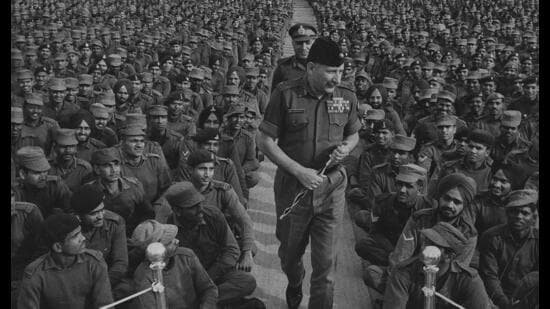
I will start with the most celebrated of them all, Field Marshal Sam Manekshaw. He led India to victory in the 1971 war, forced a surrender from the Pakistan army, and enabled the birth of Bangladesh. I learned recently from former Army chief General VP Malik that Mankeshaw, the first (and only one of two) officer to rise to the rank of field marshal, was also a war-wounded soldier early on in his life. In the 1942 Battle of Sittang, while leading his company against Japanese forces, he took nine bullets in his stomach and intestines. He was so grievously wounded that the surgeon hesitated to operate on him. “A mule kicked me,” he quipped, retaining his extraordinary and courageous humor through it all. Of course, Mankeshaw went on to rebuild his life and found a place in history.
Then, there is the stirring account of Major General Ian Cardozo who fought in the same 1971 war that Manekshaw led. A Gorkha Rifles officer, Cardozo lost his right leg in a landmine explosion in Sylhet, then East Pakistan. There is the iconic tale of how he turned around, even as skin fell off his bones and asked for his khukricommanding his batman to cut off his mangled, bleeding leg so he could carry on into battle.
The extraordinary soldier became the first war-disabled officer to command a battalion and later, a brigade. He convinced the Army that even as an amputee he could hike through snow and ice and do what was needed. He refused to be relegated to a desk.
Finally, let’s talk about Lieutenant General Vijay Oberoi, one of India’s most decorated officers, who lost his right leg in the 1965 war between India and Pakistan. Not only did he serve for another four decades, he also ran marathons with a prosthetic limb, founded the War Wounded Foundation to focus on rehabilitating disabled soldiers and rose to become the vice chief of the Indian Army.
These are national heroes to be cherished and emulated. And there are countless others like them.
Cardozo and Oberoi are generals who completed normal tenures in the service. This is a testimony to their courage and resilience. Should men like them be taxed on their disability pension? That too, in the later years of their lives, when they may especially need financial security.
Most recently, the country applauded as Corporal Varun Kumar received a Vayu Sena Medal for gallantry. He lost his right arm in an enemy missile strike during Operation Sindoor. The photograph of him saluting the air chief with his left hand, a big smile on his face, was utterly moving. He returned to service after undergoing extensive recovery and training and learning to function with his left hand. Should men like him be penalized because they are amazingly resilient?
Data shows that 10,000-12,000 armed forces personnel receive disability pensions across the Army, Navy and Airforce.
The expenditure to the government is hardly staggering; the move is penny wise, pound foolish, as General Malik says. But more than number crunching, it is about preserving the dignity of the soldier. No soldier should have to negotiate or fight for this. Finance minister Nirmala Sitharaman must reconsider this move.
As the wife of a serving soldier who lost a leg in Kashmir in a terror encounter told me in a letter she shared, “Does losing a leg cease to be a disability because one continues to serve?”
Barkha Dutt is an award-winning journalist and author. The views expressed are personal